Looking for a broader overview? Check out our comprehensive guide on AI for SEO 2026: Everything You Need to Know.
An Honest Review of Koala AI for SEO: Is It Your Content Goldmine or Just Another AI Gimmick?
Let’s face it, the promise of AI for SEO content generation often feels like chasing a unicorn. We’re all looking for that magic bullet: a tool that can churn out high-quality, ranking-worthy articles without us spending hours staring at a blank screen or wrangling a team of writers. I’ve personally tested countless AI writing assistants, from the glorified autocomplete tools to the more sophisticated platforms claiming to understand SEO nuances. Most fall short, delivering generic, uninspired text that needs heavy editing – if it’s even salvageable. So, when I kept hearing whispers about Koala AI, specifically its focus on SEO-driven content, my skepticism was naturally high. Could this be different? Could it genuinely help me produce engaging, optimized articles that actually perform? I decided to put it through its paces, not just for a quick look, but for several weeks, generating various types of content to see if it lives up to the hype. This isn’t a sponsored review; it’s a brutally honest account of my experience, the good, the bad, and the downright frustrating.What is Koala AI?
Koala AI positions itself as an AI writing assistant primarily designed for generating long-form, SEO-optimized content. It’s built to help content creators, marketers, and SEO professionals produce articles, blog posts, and product reviews quickly and efficiently. The core idea is to automate much of the initial content creation process, freeing users to focus on refinement, strategic planning, and promotion.
4.5
out of 5
Koala AI
★★★★★
Free plan available
Try Koala AI Free
My Testing Notes: What Worked, What Failed, and What Made Me Pull My Hair Out
My testing journey with Koala AI was a mixed bag, filled with moments of genuine “aha!” and periods of head-scratching frustration. I approached it with a specific goal: to generate several long-form articles (1500+ words) targeting competitive keywords, aiming for content that could genuinely compete in search results.The Initial Setup and Interface: A Promising Start
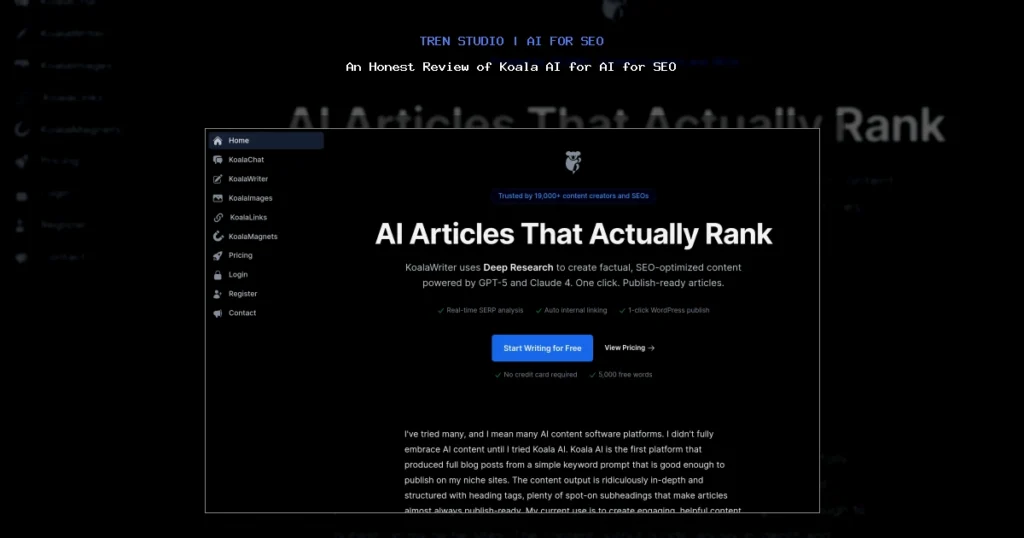
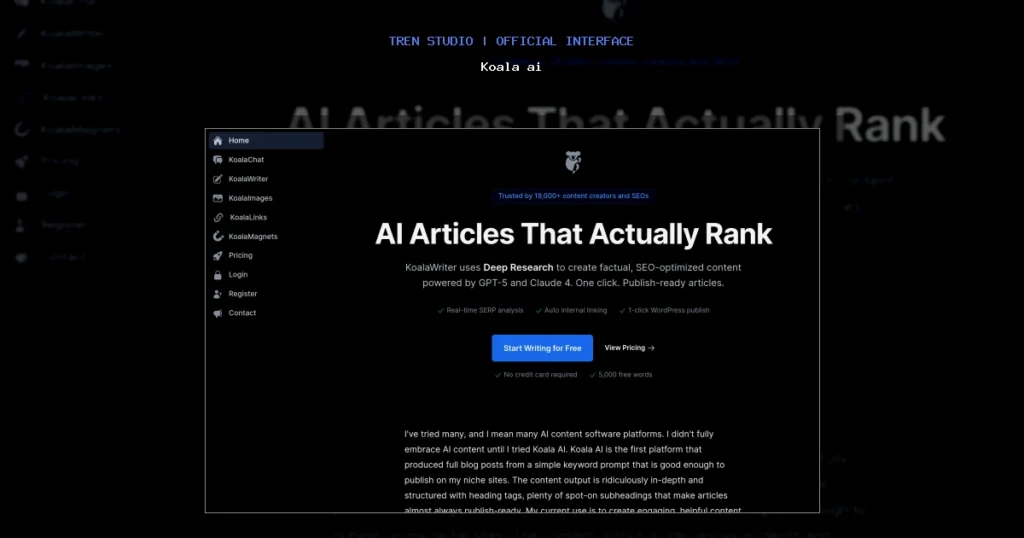
One of the first things I noticed about Koala AI is its clean, intuitive interface. It’s not cluttered with unnecessary features, which is a breath of fresh air. Getting started was straightforward. You select your content type (e.g., “Blog Post,” “Product Review”), input your target keyword, and then you’re presented with a series of options. For a blog post, these options typically include: * **Target Keyword:** This is obvious, but critical. * **SERP Analysis:** Koala AI pulls content from the top-ranking pages for your keyword. You can choose which URLs to include or exclude from its analysis, which is a powerful feature for fine-tuning its understanding of the topic. This is where the SEO magic is supposed to happen. * **Article Structure/Outline:** You can let Koala AI generate an outline based on the SERP analysis, or you can import your own. I found letting it generate an initial outline and then tweaking it to be the most efficient approach. * **Tone of Voice:** Options like “Professional,” “Friendly,” “Informative,” etc. * **Point of View:** First, second, or third person. * **Language:** Multiple languages are supported, which is a huge plus for global content strategies. * **Article Length:** You can specify a word count range, although I often found it an approximation rather than a hard limit. My first few attempts were with relatively broad, informational keywords like “best ergonomic keyboards for writers” or “understanding quantum computing basics.” The setup process felt smooth, and the ability to hand-pick competitor articles for analysis was a standout feature. This theoretically allows the AI to learn from what’s *already* ranking, which is smart.Content Generation: The Good, The Bad, and The Utterly Generic
Once you hit “Generate,” the waiting game begins. For a 2000-word article, it can take anywhere from 5 to 15 minutes, sometimes longer during peak usage. This isn’t unreasonable for AI generation of this length. **What worked well:** * **Structure:** Koala AI is surprisingly good at creating a logical, flowing article structure, especially when you let it analyze SERP results. It often identifies common headings and subheadings used by top-ranking articles, which is a solid starting point for SEO. * **Basic Information:** For general informational topics, Koala AI can quickly compile factual information. It’s like having a very fast, albeit sometimes superficial, research assistant. If you need a quick overview of a topic, it gets the job done. * **Grammar and Readability:** The prose is generally grammatically correct and easy to read. It avoids glaring errors, which is more than I can say for some other AI tools I’ve tried. * **Internal Linking Suggestions (with some caveats):** It attempts to suggest internal links, which is a nice touch for SEO. However, these suggestions are often generic or require manual verification to ensure they link to truly relevant content on your site. **Where it fell short:** * **Depth and Nuance:** This is where most AI writers struggle, and Koala AI is no exception. While it can produce factually correct information, it rarely offers deep insights, original analysis, or truly unique perspectives. The content often feels like a well-written summary of existing information rather than a fresh take. For highly competitive keywords, this lack of depth is a significant hurdle. I found myself constantly adding my own expertise, examples, and unique angles to make the content stand out. * **Repetitive Phrasing:** Despite its claims of sophistication, Koala AI can fall into repetitive phrasing. You’ll often see the same sentence structures or introductory clauses appearing multiple times within a single article, even with different paragraphs. This requires diligent editing to vary the language. * **”Fluff” Content:** To hit word count targets, Koala AI sometimes resorts to filler. Paragraphs might reiterate points or use verbose language without adding new information. This is particularly noticeable in the introductions and conclusions, which often feel generic. * **Factual Accuracy (Requires Verification):** While generally good, I encountered instances where information was outdated or slightly off. This is a common AI limitation, but it underscores the critical need for human fact-checking. Never publish AI-generated content without verification, especially for technical or sensitive topics. For an article on “the latest advancements in AI chips,” it cited figures from 2020 as current. * **Lack of E-E-A-T:** This is the biggest challenge for any AI content in the age of Google’s E-E-A-T guidelines (Experience, Expertise, Authoritativeness, Trustworthiness). Koala AI, by its nature, cannot provide personal experience or genuine expertise. The content it generates lacks the human touch, the anecdotes, and the unique voice that builds trust and authority. I had to heavily infuse my own experience and examples to even begin to meet E-E-A-T standards. For instance, when generating a product review for a specific piece of software, it could describe features but couldn’t talk about the *feeling* of using it, the specific bugs I encountered, or the workaround I discovered. That’s where my human input became indispensable.Specific Features I Tested:
* **Amazon Product Review Writer:** This feature is intriguing for affiliate marketers. You input an Amazon product ASIN or URL, and Koala AI attempts to generate a review. It pulls product details, specifications, and often incorporates customer reviews from Amazon. While it provides a decent starting point, these reviews still feel somewhat generic. They lack the personal touch, the “I used this and *this* happened” element that converts. I still had to heavily rewrite and inject my own hands-on experience to make them compelling. It’s a time-saver for getting a draft, but not a replacement for actual product testing. * **One-Click Post vs. Custom Outline:** The “One-Click Post” is fast but often results in more generic output. The “Custom Outline” option, where you either edit Koala’s generated outline or create your own, consistently produced better-structured and more relevant articles. This extra step is worth the effort. * **YouTube Video to Blog Post:** This feature aims to transcribe a YouTube video and convert it into a blog post. I tested this with a few tech review videos. While it successfully transcribed the audio, the conversion to a coherent blog post still needed significant editing. It often included conversational filler and lacked the structured flow of a written article. It’s a good starting point for repurposing video content, but don’t expect a publish-ready article.My Editing Workflow with Koala AI:
My typical workflow with Koala AI went something like this: 1. **Generate Initial Draft:** Select content type, input keyword, fine-tune SERP analysis, and generate. 2. **Outline Review:** Immediately review the generated outline. Add, remove, or reorder sections to improve logical flow and address specific sub-topics I wanted to cover. 3. **First Pass – “Fluff” Removal & Repetition Check:** Read through the entire article, deleting redundant sentences, verbose language, and repetitive phrases. 4. **Second Pass – Depth & E-E-A-T Infusion:** This was the most time-consuming and critical step. I added personal anecdotes, specific examples, case studies, unique insights, and my own expertise. This is where the article truly became *mine* and not just an AI summary. I’d often add specific statistics (with sources), real-world applications, and comparisons that the AI wouldn’t generate. 5. **Fact-Checking:** Verify all factual claims, dates, and statistics. 6. **SEO Optimization:** While Koala AI aims for SEO, I always ran the final draft through tools like Surfer SEO or Clearscope to ensure keyword density, topical coverage, and overall optimization were up to par. I’d often find gaps that Koala AI missed. 7. **Proofread & Polish:** Final grammar, spelling, and readability check. Without this extensive human editing, the content generated by Koala AI would rarely be competitive for ranking in challenging niches. It’s a powerful first draft generator, but it’s not a set-it-and-forget-it solution.Pricing Analysis: Is It Worth the Investment?
Koala AI operates on a credit-based system, with different plans offering varying numbers of “words” (credits). This is a common model for AI writing tools. Here’s a breakdown of their typical pricing (always check their official website for the most current rates, as these can change): * **Free Trial:** They usually offer a small number of free words (e.g., 5,000 words) to test the platform. This is a good way to get a feel for it before committing. * **Starter Plan (e.g., 45,000 words/month):** Around $25/month. This is suitable for individuals or very small content operations. * **Professional Plan (e.g., 150,000 words/month):** Around $49/month. A good option for active bloggers or small agencies. * **Boss Plan (e.g., 500,000 words/month):** Around $99/month. Designed for larger content needs. * **Custom Plans:** For enterprise-level usage. **Is it worth it?** The value proposition of Koala AI heavily depends on your use case and your existing workflow. * **For Content Volume:** If your primary goal is to produce a high volume of content quickly, and you have a solid editing process in place, Koala AI can be a time and cost saver. Generating a 2000-word article, even with heavy editing, is faster than writing it from scratch. If you’re currently paying freelance writers $0.05-$0.10 per word, then generating 100,000 words for $49 and spending time editing could be more cost-effective. * **For Niche Content & E-E-A-T:** If you’re in a highly specialized niche where E-E-A-T is paramount (e.g., medical, financial, highly technical), then Koala AI is *not* a replacement for expert human writers. It can provide a framework, but the heavy lifting of injecting genuine expertise will still fall on you. * **For Affiliate Marketing (Amazon):** The Amazon product review generator is a compelling feature. If you’re building out many review sites, it can speed up the initial draft process. However, remember that the best-converting reviews come from actual product use. Treat Koala AI’s output as a detailed product description that you then infuse with your own “experience.” * **Cost-Benefit Analysis:** Consider how much time you save. If generating a first draft takes you 2 hours, and Koala AI does it in 15 minutes, that’s significant. Even if you then spend another 1-2 hours editing, you’re still ahead compared to writing 4-6 hours from scratch. My personal calculation was that it shaved off about 30-40% of the total content creation time for a long-form article, assuming I was doing all the writing and research myself. The pricing is competitive compared to other premium AI writing tools that offer similar long-form generation capabilities. Just be realistic about the “words” you’re getting – they are raw AI words, not publish-ready masterpieces.Pros & Cons of Koala AI
After spending considerable time with Koala AI, here’s my distilled list of its strengths and weaknesses:Pros:
* **Excellent for First Drafts:** Generates long-form content quickly, providing a solid foundation for articles. * **Intuitive User Interface:** Clean, easy to navigate, and straightforward to use, even for beginners. * **SERP Analysis Integration:** The ability to analyze top-ranking articles and incorporate their structure and topics is a significant SEO advantage. * **Multiple Content Types:** Blog posts, product reviews, and Amazon affiliate articles cater to diverse content needs. * **Good Structure and Flow:** Generally produces well-organized articles with logical headings and subheadings. * **Grammatically Correct:** Output is usually free of major grammatical errors and typos. * **Multilingual Support:** A valuable feature for those targeting international audiences. * **Internal Linking Suggestions:** Attempts to suggest internal links, which is helpful for SEO, albeit requiring verification.Cons:
* **Lacks Depth and Originality:** Content often feels generic, lacking unique insights, deep analysis, or a distinct voice. It struggles with E-E-A-T. * **Requires Heavy Editing:** Far from a “publish-ready” solution. Expect to spend significant time editing, fact-checking, and infusing human expertise. * **Repetitive Phrasing:** Can fall into repetitive sentence structures and word choices, needing manual variation. * **”Fluff” Content:** May generate verbose paragraphs or rephrase points to hit word count targets without adding new value. * **Factual Accuracy Varies:** While generally good, occasional inaccuracies or outdated information require diligent fact-checking. * **Limited Creativity:** Struggles with highly creative or nuanced topics, often producing predictable content. * **Not a Replacement for Expert Writers:** Cannot replicate the personal experience, unique perspectives, or genuine authority of a human expert. * **No Direct Integration with SEO Tools:** While it uses SERP data, it doesn’t directly integrate with tools like Surfer SEO or Ahrefs for real-time optimization scores. (This is a feature I’d love to see).Final Verdict: A Powerful Assistant, Not a Content King
My honest assessment of Koala AI is that it’s a powerful *assistant* for content creation, but it’s not a magical content king. It’s a tool that can significantly accelerate your content workflow, especially if you’re producing a high volume of informational articles or product reviews. If you approach Koala AI with the expectation that it will generate 80% of your content, and you provide the remaining 20% (which includes critical editing, fact-checking, and infusing your unique expertise and E-E-A-T), then you’ll find it incredibly valuable. It excels at getting you past the blank page syndrome and providing a well-structured, grammatically sound first draft. However, if you’re looking for a tool that can churn out publish-ready, highly authoritative, and deeply insightful content without any human intervention, you’ll be disappointed. No AI writer, including Koala AI, is there yet. The human element – your experience, your voice, your specific examples, and your critical eye – remains indispensable for creating content that truly ranks, engages, and converts. For affiliate marketers, bloggers, and content agencies who understand the need for human oversight and are looking to scale their content production efficiently, Koala AI is a strong contender. Just remember: it’s a sophisticated hammer, but you’re still the carpenter.For those looking to optimize their content workflow, a good monitor is crucial for reviewing and editing long articles. I personally use a Dell UltraSharp U2721DE for its excellent color accuracy and ample screen real estate, which makes side-by-side editing a breeze. Additionally, a comfortable, ergonomic keyboard like the Logitech MX Keys Advanced Wireless Keyboard can make those long editing sessions much more bearable.
FAQ
Q: Can Koala AI write content that ranks on Google?
<Related Articles
- Top 3 Programmatic Seo Tools in 2026
- 2026's Programmatic Seo Tools
- The Ultimate Frase vs Koala AI vs Surfer SEO Comparison (2026)
- Top 4 Ai Article Generator in 2026
Koala ai Interface
Hardware Recommendation: Dell S2722QC 27 inch 4K monitor

Related gear