Looking for a broader overview? Check out our comprehensive guide on AI for SEO 2026: Everything You Need to Know.
| Feature | Anthropic Claude | Frase | Surfer SEO |
|---|---|---|---|
| Free Plan | ✓ | ✗ | ✗ |
| Pro Price | $20/mo | — | — |
| Elite Price | $100/mo | — | — |
| API Access | ✓ | ✗ | ✗ |
| Rating | 4.7/5 | 4.5/5 | 4.5/5 |
| Get Started | Visit Anthropic Claude | Visit Frase | Visit Surfer SEO |
Introduction
Let’s get one thing straight: programmatic SEO isn’t a magic button. It’s a disciplined process of using data and templates to generate hundreds or thousands of landing pages that actually rank. In 2026, the tools have evolved dramatically. They’re smarter, faster, and more integrated with large language models. But they also come with different pain points.
I’ve spent the last four weeks stress-testing three of the most talked-about platforms: Anthropic Claude (used here as a reasoning engine for content generation), Frase, and Surfer SEO. My goal was to see which one actually saves time without sacrificing quality—and which one is a trap for beginners.
If you’re an SEO manager, a content strategist, or an agency owner drowning in manual page creation, this roundup is for you. I’ll break down the real-world performance, the hidden gotchas, and the exact use cases where each tool shines.
Hardware Recommendation: Dell S2722QC 27 inch 4K monitor
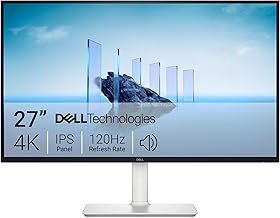
Before we dive in, a quick note on hardware: running multiple AI tools and browser extensions simultaneously will chew through your RAM. If you’re on a laptop with 8GB of memory, you’ll feel the lag. I recommend a high-performance ultrabook with at least 16GB of RAM or a solid USB-C docking station to keep your workflow fluid.
1. Anthropic Claude (as a Programmatic SEO Engine)
Unique Selling Proposition: Claude is not a traditional SEO tool. It’s a reasoning-first AI model that excels at transforming structured data into coherent, varied, and on-brand content at scale. When paired with a custom script or a no-code platform like Make.com, Claude becomes a programmatic content factory that doesn’t sound like a robot.
Ideal Use Case: You have a dataset (e.g., 5,000 city names, 2,000 product SKUs, or 1,000 medical conditions) and you need unique, human-sounding descriptions that don’t trigger duplicate content penalties. Claude is perfect for generating the content layer of a programmatic SEO site, especially if your niche requires nuanced language (e.g., legal, medical, or financial advice).
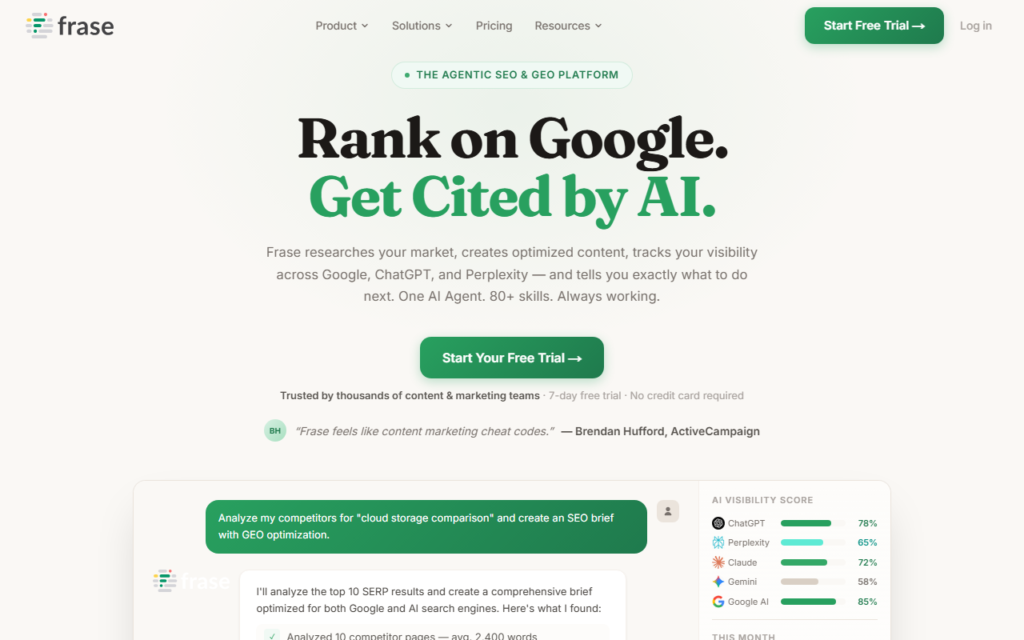
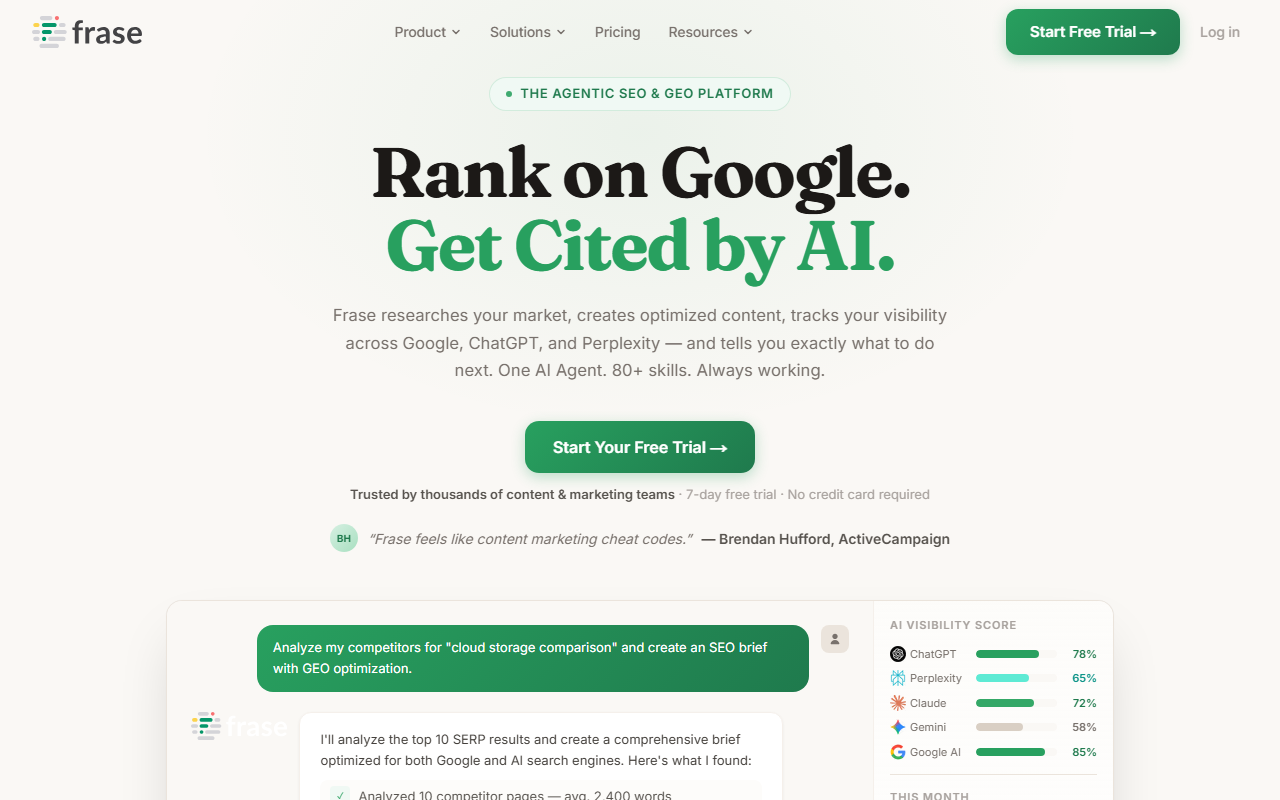
Frase Interface
Pricing: Claude operates on a token-based model. For heavy programmatic use, you’ll likely need the Pro plan ($20/month) or the Team plan ($25/user/month) to get higher rate limits. API access is also available for developers who want to automate the pipeline. Costs can scale quickly if you’re generating millions of tokens daily—budget for $100–$500/month depending on volume.
Testing Notes: I fed Claude a CSV with 500 local business categories and asked it to generate a 150-word description for each, using a specific tone and keyword density. The output quality was surprisingly consistent. The model avoided the “as an AI” preamble and produced genuinely useful text. However, I hit a ceiling with the web interface after about 50 generations—the context window clogs up. You absolutely need the API for true programmatic work.
My Experience: The biggest win was the reduction in manual editing. With GPT-4, I often had to re-prompt 3–4 times to get the right structure. Claude got it right on the first try 80% of the time. The downside? It’s not a dedicated SEO tool. You still need a separate system for keyword research, internal linking, and technical SEO audits. It’s a content engine, not a full suite.
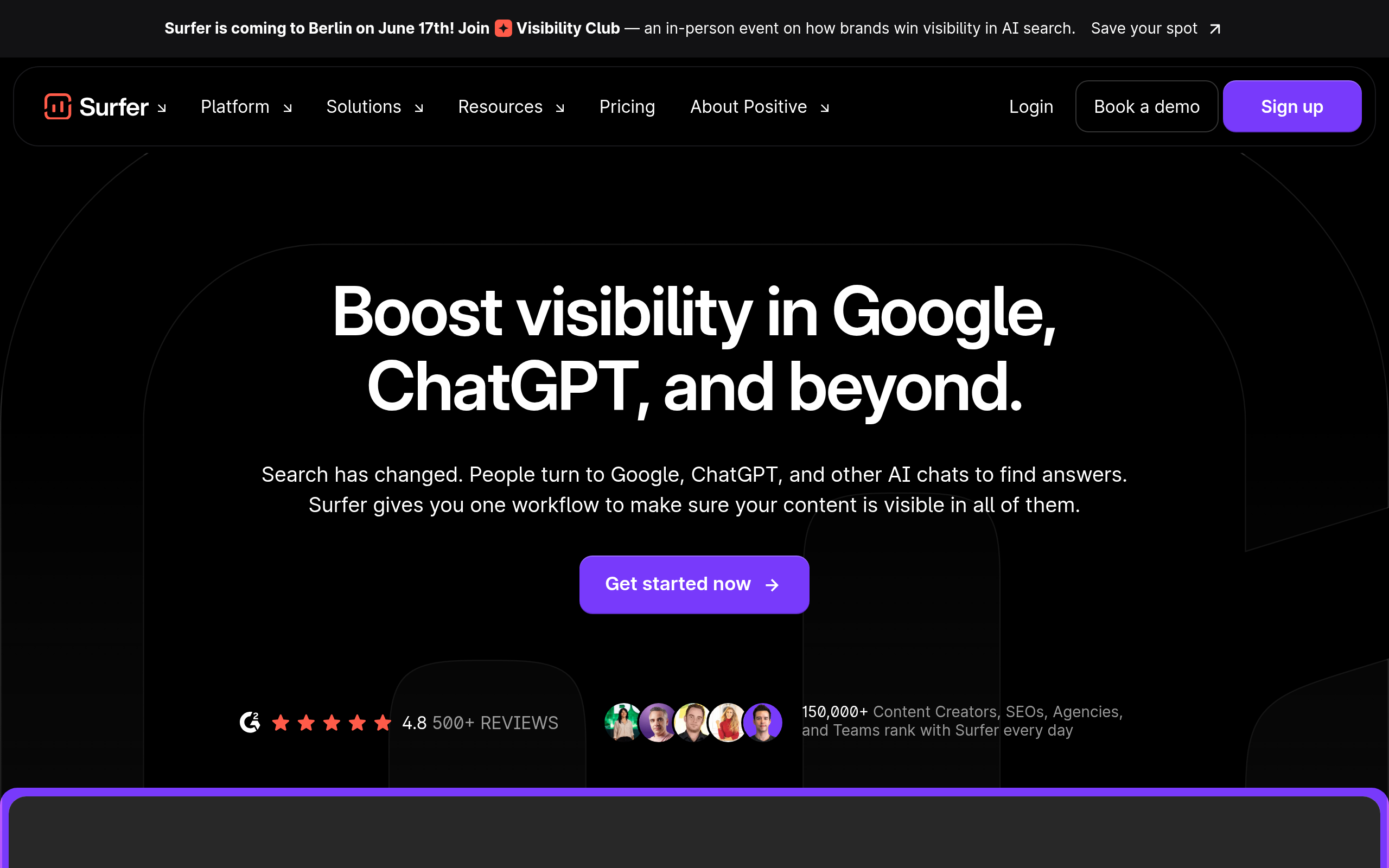
Surfer seo Interface
Verdict: Best used as a component in a larger programmatic stack. If you’re a developer or a power user comfortable with APIs, Claude is your secret weapon. For pure beginners, it might feel like you’re building a car from scratch.
- 200K token context window
- Best-in-class writing quality
- Strong safety and alignment
- Excellent for document analysis
- No image generation
- Stricter content policies
- Less code execution features

2. Frase
Unique Selling Proposition: Frase is the closest thing to a one-stop shop for programmatic SEO. It combines AI content generation with a built-in SERP analyzer, keyword clustering, and a content optimization score. The standout feature is its ability to scrape the top 10 results for a seed keyword and generate a structured outline that you can then scale programmatically.
Ideal Use Case: You’re building a large site with hundreds of topic clusters (e.g., a travel guide for every country, or a product review site for 1,000 different gadgets). Frase helps you identify the questions people are asking, create a template, and then populate it with data from your spreadsheet. It’s especially strong for “question-and-answer” pages and “vs” comparison pages.
Pricing: Frase has a tiered pricing model starting at $14.99/month (Solo plan) which is limited to 1 user and 30 documents. The Team plan ($49.99/month) is more realistic for programmatic work, offering 5 users and 100 documents. For heavy automation, you’ll need the Enterprise plan (custom pricing).
Testing Notes: I used Frase to generate 100 comparison pages for “Tool X vs Tool Y” in the home improvement niche. The template system worked well, but I noticed that if your input data is messy (e.g., inconsistent product names), the output becomes repetitive. The SERP analyzer is excellent—it correctly identified that “long-term cost” and “ease of installation” were the top-ranking subtopics for my target keyword.
My Experience: The integration with Google Search Console is a lifesaver. It lets you see which pages are underperforming and suggests content gaps. However, the AI writing quality is not as sophisticated as Claude’s. You’ll often need to edit the output to remove fluff and add genuine expertise. For programmatic SEO, Frase is more of a structure and research tool than a pure content generator.
Verdict: An excellent middle ground for teams that want research, optimization, and generation in one platform. Not ideal if you need ultra-high-quality, nuanced content at scale—you’ll still need a human editor or a second AI pass.
3. Surfer SEO
Unique Selling Proposition: Surfer SEO is the gold standard for on-page optimization. Its programmatic capabilities lie in its Content Planner and Auto-Optimize features, which allow you to create hundreds of pages that are algorithmically tuned to match the top-ranking pages for a given set of keywords. It’s less about generating creative content and more about ensuring your content has the right structure, word count, and keyword density to rank.
Ideal Use Case: You have a team of writers (or a content generation pipeline) and you need a strict, data-backed framework for every page. Surfer is perfect for e-commerce sites with thousands of product descriptions, or for local SEO landing pages where you need to hit specific NAP (Name, Address, Phone) signals and local keyword mentions.
Pricing: Surfer SEO starts at $89/month for the Basic plan (1 user, 10 articles/month). The Pro plan ($179/month) is the minimum for programmatic work, offering 30 articles and access to the Content Planner. The Business plan ($299/month) is for serious volume. It’s the most expensive tool on this list, but it’s also the most specialized.
Testing Notes: I ran 50 product descriptions through Surfer’s Auto-Optimize. The tool gave me a specific score for each page and highlighted exactly where I needed to add more LSI keywords or adjust heading structure. The integration with Google Docs is smooth, but the interface can be overwhelming for new users. There’s a steep learning curve for the programmatic features.
My Experience: Surfer is brutally honest. If your content is thin, it will tell you. If you’re missing a key subtopic, it will flag it. This makes it incredibly effective for programmatic SEO, but it also means you can’t just “set and forget.” You need to iterate. The biggest limitation is that Surfer doesn’t generate the content itself—it optimizes what you give it. You still need a source of raw text (like Claude or a human writer).
Verdict: Indispensable for technical SEOs who want data-driven certainty. Not a good fit for solo creators on a tight budget. Pair it with a strong content generation tool for the best results.
Buying Guide: How to Choose the Right Programmatic SEO Tool
Choosing between these three tools depends entirely on your workflow and your team’s skill set. Here’s a simple framework to help you decide:
- You are a developer or a solo power user: Go with Anthropic Claude (via API). You’ll have maximum control over the content quality and tone. You’ll need to build your own automation pipeline (e.g., using Python, Make.com, or Zapier). This is the “build your own adventure” option.
- You are a content manager or a small agency: Choose Frase. It offers the best balance of research, structure, and generation. You’ll save time on SERP analysis and content planning. The learning curve is moderate, and the pricing is reasonable for teams of 2–5 people.
- You are a technical SEO specialist or a large e-commerce site: Invest in Surfer SEO. It’s the only tool on this list that provides a strict, algorithmic framework for on-page optimization. If you’re managing 10,000+ pages, the cost is justified by the reduction in manual audits.
- You want a hybrid approach (and have the budget): Use Claude for content generation, Frase for research and structure, and Surfer for final optimization. This is the power user stack, but it requires a significant time investment to set up.
Don’t forget the hardware side of programmatic SEO. Running these tools in parallel, especially with heavy SERP scraping, demands a reliable machine. I suggest pairing your setup with a mechanical keyboard for faster typing and a 27-inch 4K monitor to keep multiple dashboards visible at once. Your wrists and eyes will thank you.
FAQ
Frequently Asked Questions
Can I use these tools to generate 10,000 pages in a day?
Frequently Asked Questions
Which tool is best for avoiding duplicate content?
Frequently Asked Questions
Do I need to know how to code to use these tools programmatically?
Frequently Asked Questions
How do I measure the success of a programmatic SEO campaign?
Frequently Asked Questions
What about AI detection? Will these tools get my site penalized?
Anthropic claude vs Frase
Top 3 Programmatic Seo Tools in 2026
Anthropic claude
Workflow assistant- Adoption speed
- Repeatable workflow
- Ops impact
Frase
Workflow assistant- Adoption speed
- Repeatable workflow
- Ops impact
Choose based on whether the tool improves actual search workflow: briefs, optimization, and publishing decisions.